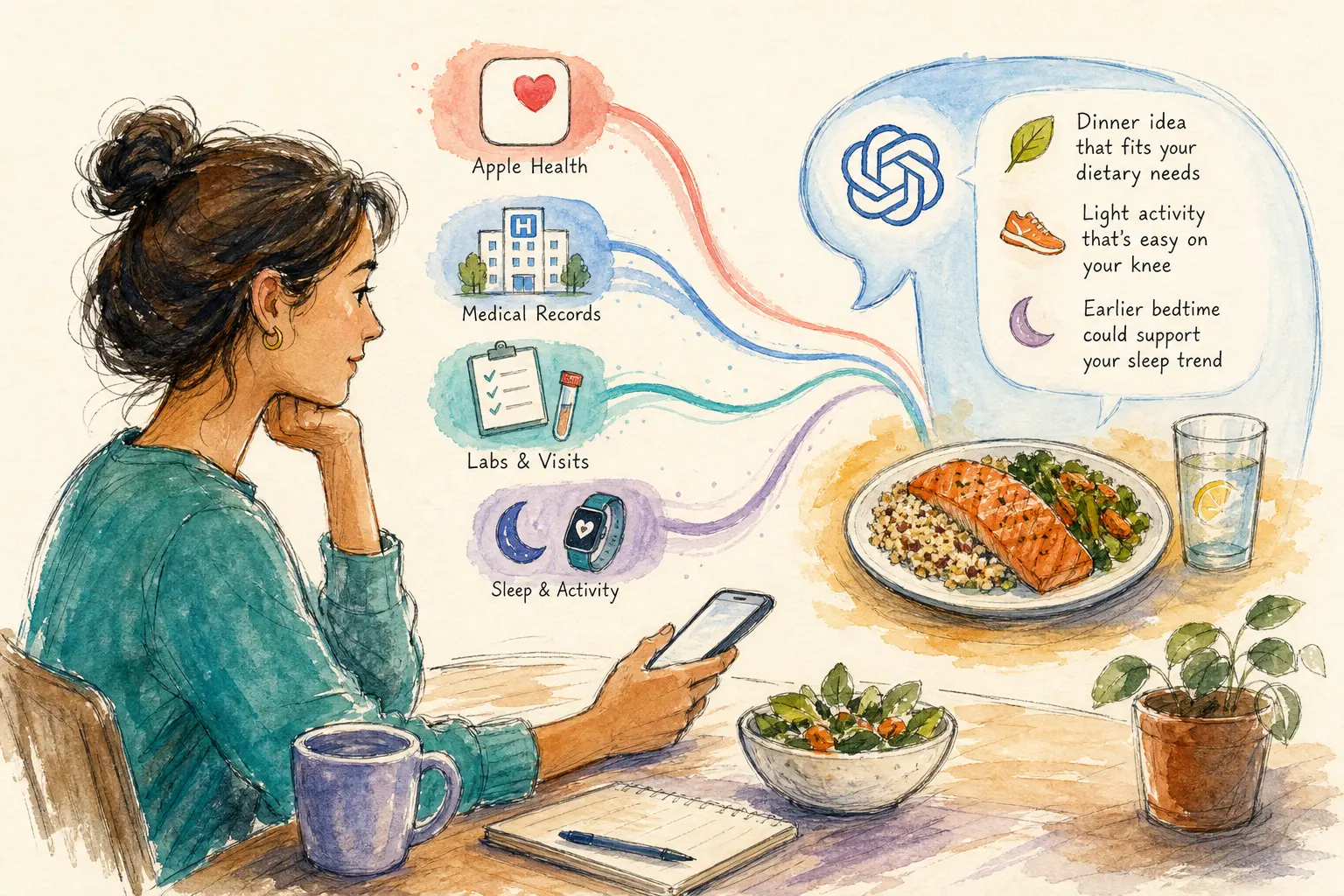
OpenAI is rolling out a Health feature in ChatGPT that can draw on Apple Health data and, where supported, patient records from selected health systems. The change matters because it moves health context into ordinary ChatGPT conversations, making it easier for users to ask about symptoms, routines, or plans without first switching into a separate health mode.
The feature is available now to logged-in users aged 18 and older on web and iOS across the Free, Go, Plus, and Pro tiers.
How the new Health feature works
Users can connect Apple Health and, in supported cases, records from US hospital systems, One Medical, or Function Health. Once connected, ChatGPT can use information such as medications, lab results, recent visits, sleep data, and activity logs when answering questions.
That is a change from OpenAI’s earlier approach. A smaller test group had to open a dedicated health area to get answers grounded in their own data. OpenAI says it found that more than 70 percent of health-related conversations in that test happened elsewhere in the app, often during unrelated chats. The redesign is meant to reflect that behavior.
In practice, the new setup means a user could ask about dinner plans and receive a suggestion that takes a dietary restriction into account, or ask about weekend activities and get an answer that reflects a recent injury in synced records.
The Health tab remains in the sidebar, but its role is now mainly administrative: connecting accounts, reviewing synced data and trends, browsing suggested prompts, and returning to previous health chats.
What testers say the tool helps with
OpenAI shared examples from early users that show the feature being used more as an organizing and interpretation aid than as a diagnostic system.
Some testers said it helped them turn scattered records into a timeline they could understand and share with clinicians or trainers. Others said the value was in spotting patterns over time across connected labs and other data sources. One user described using it to keep exercise suggestions realistic after a stretch of inactivity. Another said the feature made it easier to stop exporting Apple Health spreadsheets and re-uploading them manually.
A nurse in the test group also noted that the tool surfaced an unexpected chart entry, which she then planned to follow up on with her healthcare providers. That example underscores the boundary OpenAI is trying to maintain: the system can help users notice and organize information, but it is not being positioned to make clinical decisions.
OpenAI’s health-model claims
OpenAI says the feature is supported by newer models, including GPT-5.5 Instant for Free users and GPT-5.6 Sol for paid tiers. The company says GPT-5.5 Instant improved at recognizing when urgent care may be needed and at explaining uncertainty, while GPT-5.6 Sol is designed to reason across multiple data points, such as lab trends over time.
To test those claims, OpenAI says it worked with hundreds of physicians to create health scenarios and scoring rubrics covering accuracy, safety, communication, context awareness, completeness, and when to escalate to professional care. It says its GPT-5.6 models outperformed GPT-5.5 on HealthBench Professional, an internal evaluation built for this purpose.
OpenAI also says physicians tested the live product before release for real-world performance and safety with connected data, though it has not published detailed methodology or results from that testing.
Privacy, permissions, and data retention
OpenAI says connected medical records, Apple Health data, and any conversations that rely on them are excluded from foundation model training and ad targeting. That applies even if a user has different training settings elsewhere in ChatGPT.
Access is permission-based by default. ChatGPT asks before using connected health data to personalize a response, though users can switch to an “always allow” setting. The setting can be changed later. If a user disconnects a source, OpenAI says the data is deleted from its systems within 30 days. Existing chats that already contain the information remain until the user deletes them.
Memory creation is also limited. Health conversations can create memories, but the raw connected records themselves cannot. Users who want to avoid memory creation entirely can use Temporary Chat or disable memory in settings.
OpenAI says it also applies extra checks for actions that might expose health data through other connected plugins, such as sharing a plan based on Apple Health metrics with someone else. The company says it has run red-teaming exercises for these edge cases, but has not published the results.
The accuracy problem at the edges
The main practical question is not whether ChatGPT can summarize a clean demo dataset. It is how well it handles stale, incomplete, or conflicting information.
OpenAI itself points to one common problem: a medication can remain listed in a synced record long after a patient has stopped taking it. Its guidance is to tell ChatGPT when something has changed and to confirm important details with the original source or a healthcare professional.
There are also limits to what will sync. Wearable and fitness data depends on what third-party apps choose to share through Apple Health, and some proprietary fitness scores may not come through at all.
That means the feature’s usefulness will depend heavily on the quality of the underlying data and how carefully users treat the output. OpenAI’s physician testing addresses part of that risk, but it does not remove the challenge of helping people make sense of imperfect records across multiple apps and providers.
For eligible US users, the feature is available through the Health menu in the sidebar.