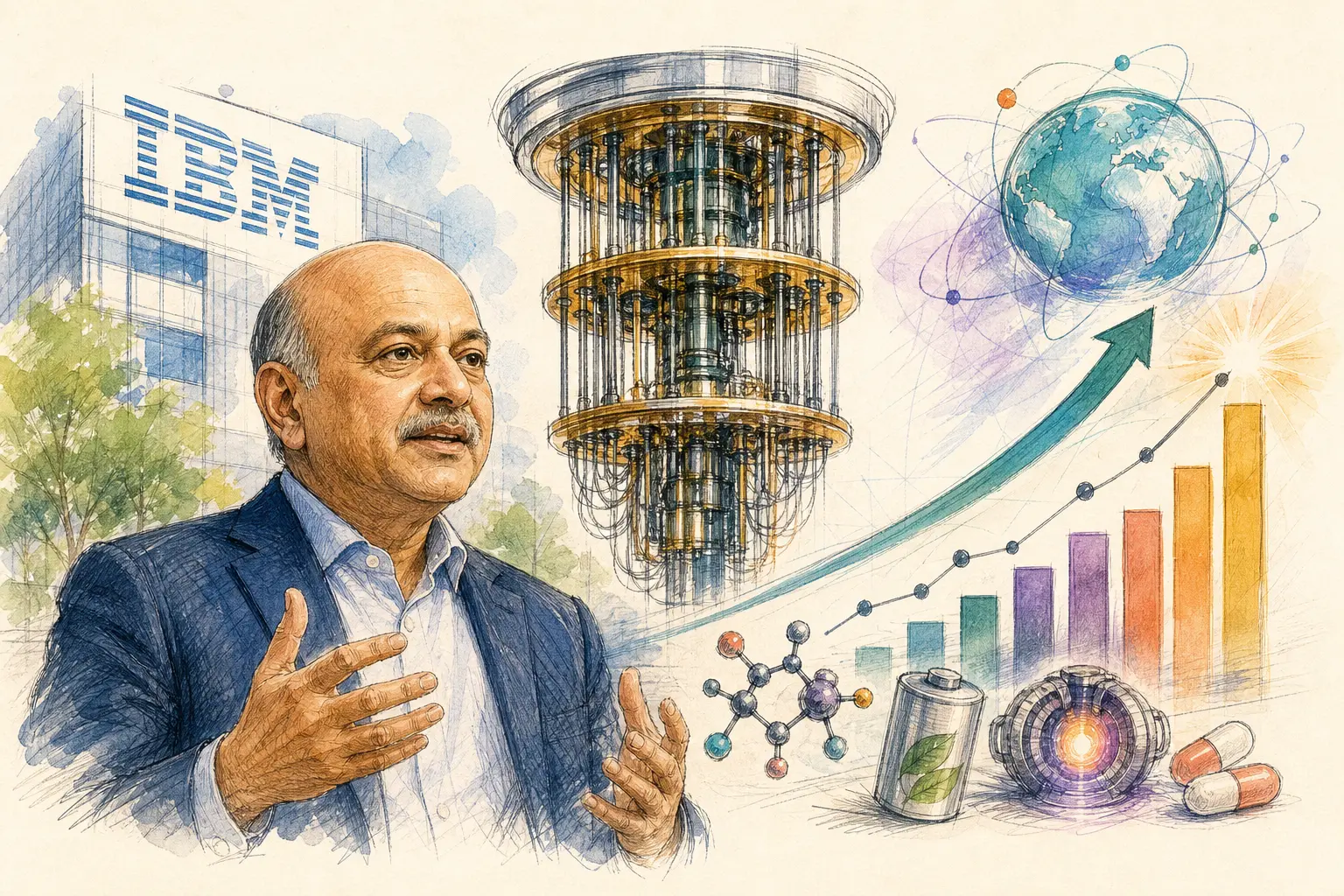
IBM CEO Arvind Krishna says quantum computing is getting close to a commercial phase, with IBM expecting the technology to start contributing meaningfully to revenue and profit by 2028 or 2029.
That timeline matters because quantum computing has long been discussed as a distant research field. Krishna’s remarks suggest that, at least for IBM, the industry may be moving toward a measurable business model before the decade ends.
What IBM is forecasting
In an interview on CNBC’s Mad Money, Krishna said IBM expects quantum computing to begin adding to the company’s financial results in the next few years. He also said IBM is now “pretty convinced” the technology could represent “a trillion dollars of value” by the end of the 2030s.
Quantum computers use the behavior of quantum mechanics — the physics of very small particles — to approach certain problems differently from classical computers, which are the standard machines used today.
Why companies care
The appeal is not general-purpose replacement for today’s computers. Instead, quantum systems are being developed for narrow problem sets where classical machines can struggle.
Examples include:
- molecular simulation
- logistics and other complex optimization problems
- materials science
- cryptography research
Krishna said IBM has already shown some early results, including using quantum computers to identify properties of materials that conventional computers could not model. IBM says those kinds of findings could eventually support longer-lasting batteries, new materials, fusion energy research and drug discovery.
The competitive race is intensifying
IBM is not alone. Alphabet, IonQ, Rigetti Computing and a range of startups are all working on quantum hardware and software. Their goal is to build systems that can solve certain problems faster or more efficiently than classical computers can today.
The industry is also seeing more money flow in. In May, IBM said it would back a standalone quantum chip foundry with a $1 billion commitment from the U.S. Department of Commerce through the CHIPS incentive program, along with a matching $1 billion from IBM itself. Other developers have also been expanding manufacturing capacity and research partnerships as they work toward fault-tolerant quantum computers — systems designed to reduce the errors that currently limit quantum machines.
Why crypto and AI are both watching
Quantum computing is often mentioned alongside AI, but the two technologies address different problems. AI has driven demand for graphics processors to train and run large language models; quantum computing is aimed at different kinds of computation entirely.
The crypto industry is also paying attention. Some bitcoin miners, including MARA Holdings, Riot Platforms and CleanSpark, have already diversified into AI and high-performance computing by using their data centers and power infrastructure for new workloads. Quantum computing, however, will not fit into those existing facilities. It needs different hardware and operating environments, which means new supply chains and new types of infrastructure.
There is also a longer-term security question: some observers worry that a powerful enough quantum computer could eventually threaten the encryption used by Bitcoin wallets and other blockchain networks. Most experts say that risk is still far off, and developers are already working on quantum-resistant cryptography, giving blockchains time to upgrade before the technology becomes a practical threat.